

Overview
Thrust 3 focuses on understanding how indoor environments, building systems, and energy use affect health, comfort, and productivity, with particular attention to public buildings and low-income housing.
Indoor Environment Systems and Modeling Frameworks
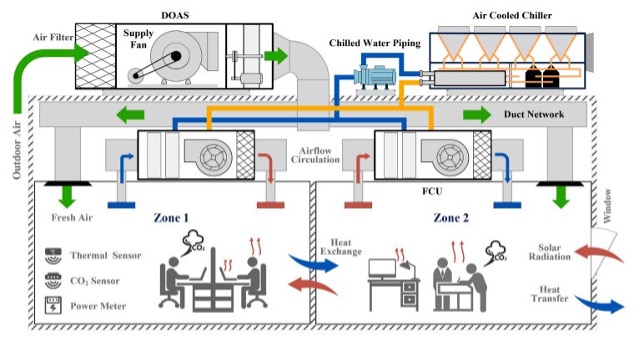
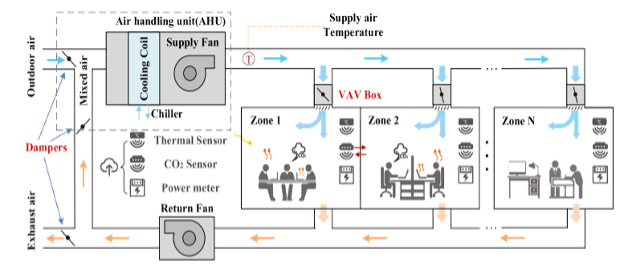
Research Focus & Methods
- Integrated models linking IAQ, thermal comfort, ventilation, and occupant productivity
- Validation across schools, offices, and residential settings
- Physics-based and data-driven HVAC optimization frameworks
- Sensor data and building simulation analysis
- Control strategies for energy efficiency, air quality, and thermal comfort
- Detailed models of low-income residential buildings
Key Themes
Current Work
We develop integrated models that link indoor air quality (IAQ), thermal comfort, ventilation, and occupant productivity in settings such as schools and offices, helping quantify the health and economic co-benefits of improved indoor environments. These models are validated across multiple real-world scenarios to support evidence-based building design and operation. At the same time, we advance physics-based and data-driven optimization frameworks for HVAC systems to reduce energy consumption while maintaining healthy and comfortable indoor conditions.
Policy & Community Relevance
A core component of this thrust is addressing environmental inequities. We build detailed models of low-income residential buildings to capture housing conditions, occupant behaviors, and common HVAC systems, and analyze disparities in energy use, comfort, and pollutant exposure (including CO₂, PM2.5, and VOCs). These insights support more equitable building standards, retrofit strategies, and policy design.